The Hidden Health Risks of Dirty Carpets (And Why Colorado Homes Are Especially Vulnerable)
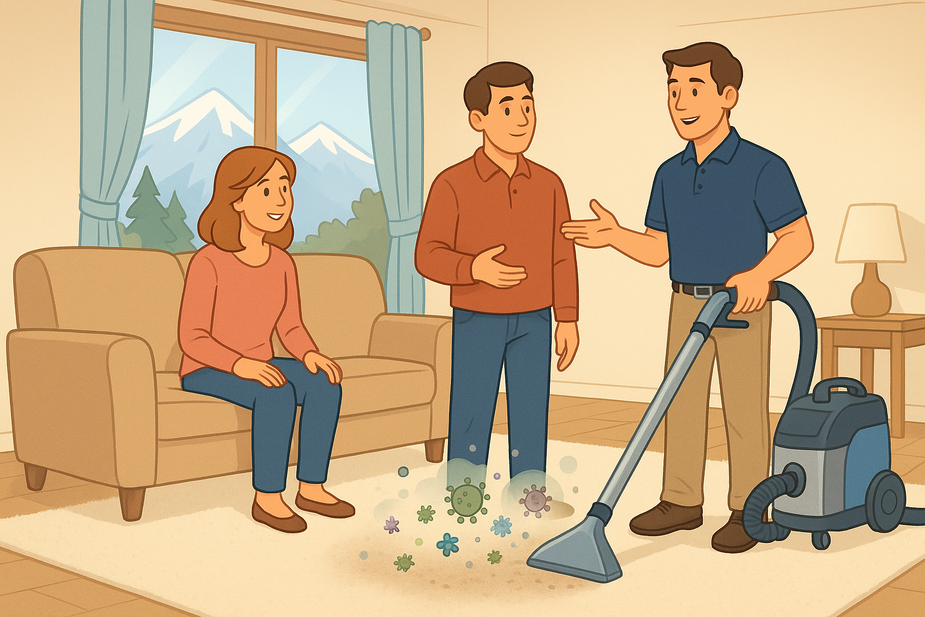
Picture a typical Tuesday afternoon in a Denver Metro Area home. The kids are sprawled across the living room carpet after school, backpacks tossed to the side. The family dog is settled into his favorite corner near the couch. A toddler pushes toy cars back and forth across the floor, occasionally pressing a hand flat against the pile before reaching back toward her snack. From the outside, the carpet looks perfectly normal — a little worn near the hallway, maybe a faint shadow where the couch used to sit, but nothing that raises any flags.
What the eye cannot see is a different story entirely.
The health risks of dirty carpets are far more significant than most homeowners realize, and they build quietly over months and years without any visible warning. The EPA and the American Lung Association both note that carpets act as reservoirs for dust, dirt, pollen, mold spores, pesticides, pet dander, and other pollutants — and that even a carpet that looks reasonably clean can be holding a substantial load of contaminants deep within its fibers. Over the next few sections, we’ll walk through the four core health concerns every Colorado homeowner deserves to understand: bacterial contamination, allergen buildup, indoor air quality and respiratory health, and hidden mold growth. The goal is not to alarm you. It is to give you the practical, honest information you need to make smart decisions about your home and your family’s wellbeing.
Why Colorado Homes Face Unique Carpet Challenges
Carpet contamination is a concern for homeowners everywhere, but Colorado homes face a compounding set of environmental factors that make the issue more acute than it might be in other parts of the country.
Start with the climate itself. Colorado’s dry, windy conditions — particularly along the Front Range — constantly stir up fine soil particles, dust, and during wildfire season, smoke particulates that settle into carpet fibers through open windows, doors, and on the clothing and shoes of everyone entering the home. Research from healthy homes studies indicates that carpets can accumulate between 5 and 25 grams of dust and dirt per square meter depending on household usage and location. For a typical living room, that adds up quickly.
Colorado winters and spring snowmelt introduce a second challenge: wet boots, damp gear, and muddy paws are regularly tracked across carpet surfaces throughout a significant portion of the year. Once moisture penetrates carpet fibers and reaches the padding beneath, it creates exactly the conditions — warmth, dampness, and available organic material — that allow microbial growth to take hold. The EPA has specifically identified damp carpet as a primary source for microbial growth that can lead to adverse health effects.
Pollen season on the Front Range adds another layer. Tree and grass pollen are carried inside on shoes, clothing, and pets and become trapped in carpet pile, where they can be released back into the breathing zone of a room during everyday foot traffic — extending allergy symptoms well past peak outdoor pollen days.
Then there is Colorado’s outdoor culture. Families who hike, trail run, camp, and spend time on dirt trails are regularly carrying organic matter, fine soil, and outdoor debris into their homes on their footwear and clothing, all of which steadily accumulate in carpet fibers over time. Each of these factors compounds the health concerns we will explore throughout the rest of this post.
Health Risk #1 — Bacteria in Carpets
Bacteria in carpets is one of the most overlooked — and most genuinely significant — health concerns associated with unclean carpet. It does not get as much attention as visible staining or odors, but the bacterial load hiding within carpet fibers in an average household is something every homeowner should understand.
Carpet functions as a highly effective biological trap. Unlike hard floors, where debris sits on the surface and can be swept or mopped away, carpet fibers grip contaminants and pull them down into the pile where they are not visible and are not reached by routine vacuuming. Every layer of the carpet system — the pile, the backing, the padding — can harbor biological material.
The sources of bacterial contamination in home carpets are numerous. Shoe traffic alone introduces a remarkable range of microorganisms. Studies have documented that shoe soles carry bacteria picked up from bathrooms, sidewalks, public spaces, and outdoor surfaces. Research has detected organisms including E. coli, Salmonella, and Staphylococcus in carpet samples, all commonly introduced through footwear brought inside from daily activities.
Pets contribute significantly as well. Urine, fecal traces, and the natural bacteria carried on paw pads and fur add to carpet contamination, particularly in high-contact zones like favorite resting spots. Food spills and crumbs provide organic material that bacteria feed and multiply on within the carpet environment. And the everyday shedding of dead skin cells by household occupants — something everyone does naturally — adds ongoing organic load to the system.
Bacteria thrive in these conditions: high-traffic areas where contaminants are repeatedly deposited and ground deeper into the pile, homes with pets and young children, and any zone where dampness exists in the carpet backing, even dampness that is not visible from the surface.
Here is the critical point that many homeowners miss: vacuuming alone does not eliminate bacteria embedded in carpet fibers and padding. Standard household vacuums are designed to remove surface and near-surface dirt effectively, but they are simply not built to address embedded microbial contamination in the lower pile and backing. Regular vacuuming is valuable and necessary — but it is not a substitute for periodic professional deep cleaning.
For young children who spend significant time on the floor and regularly engage in hand-to-mouth behavior, this is not a theoretical concern. It is a practical one worth taking seriously.
Health Risk #2 — Carpets and Allergies
Carpets and allergies have a well-documented and direct relationship — one clearly acknowledged by major health organizations including the American Lung Association. If you or anyone in your household experiences persistent allergy symptoms at home, your carpet may be playing a larger role than you realize.
Carpets are among the most significant allergen reservoirs in a home because their fibrous structure simultaneously traps allergens from multiple different sources. Understanding what those sources are helps explain why symptoms can persist year-round even in households that clean regularly.
Dust mites and dust mite waste are among the most potent indoor allergen triggers identified by health authorities. Dust mites are microscopic organisms that thrive in soft furnishings, feeding on shed skin cells. Their fecal particles are a primary driver of indoor allergic reactions — sneezing, itchy eyes, nasal congestion, and asthma attacks in sensitive individuals. This is well-established, and it applies to virtually every carpeted home regardless of how clean it appears.
Pet dander is another major contributor. The American Lung Association specifically identifies pet dander as a contaminant that settles deep into carpet fibers and is difficult to remove without high-quality vacuuming combined with periodic professional deep cleaning. For Colorado’s large population of indoor pet owners, this is a particularly relevant concern.
Mold spores can develop in the carpet backing and padding when carpet becomes damp — from spills, pet accidents, leaks, or basement humidity. Mold spores are well-established triggers for allergic reactions, respiratory irritation, and asthma episodes, particularly in people with sensitivities or compromised immune systems.
Pollen and outdoor allergens, as discussed in the Colorado conditions section, are carried inside continuously during active seasons and stored within carpet fibers, released back into the air during everyday movement through the home.
Families with young children deserve special attention here. Children playing close to the floor have greater direct contact with and inhalation of carpet-level allergens than adults moving through the same space. If your child seems to sneeze more at home than outdoors, or if allergy symptoms seem to linger even after peak outdoor pollen season passes, carpet allergen load is a rational place to look.
The practical response to the carpets and allergies connection is consistent: regular professional deep cleaning combined with thorough weekly vacuuming and reasonable humidity control is an evidence-supported strategy for meaningfully lowering allergen exposure in your home.
Health Risk #3 — Dirty Carpets and Indoor Air Quality
The health risks of dirty carpets do not stop at sneezing and skin irritation. They extend to the overall indoor air quality of your home — the air that everyone in the household breathes every hour they spend inside.
The EPA notes that indoor air can be 2 to 5 times more polluted than outdoor air, and carpets are specifically identified by environmental health researchers as both a sink and a re-release source of indoor pollutants. When you consider how many hours most families spend inside their homes — particularly children during winter months, or individuals who work from home — the quality of that indoor air has real, day-to-day health implications.
Every time someone walks across a dirty carpet, the allergens, dust, fine particles, and other contaminants that had settled into the fibers are disturbed and stirred back up into the air you breathe. This is not a rare or extreme scenario — it happens with ordinary foot traffic throughout the day. The American Lung Association has specifically warned that pollutants trapped in carpets, including dust mites, pet dander, mold spores, and fine particles, can worsen asthma, trigger allergy episodes, and contribute to chronic coughing, wheezing, sinus congestion, and breathing difficulties in both sensitive individuals and otherwise healthy people.
The groups most vulnerable to IAQ issues linked to carpet contamination are worth naming clearly. Children, whose respiratory and immune systems are still developing and who spend a disproportionate amount of time at floor level, face the most significant direct exposure. Older adults with reduced respiratory resilience are also more affected. And anyone with pre-existing asthma, chronic respiratory conditions, or environmental sensitivities can experience measurable worsening of their symptoms in a home with high carpet contaminant load.
There is also a Colorado-specific consideration worth noting. At the altitude of the Denver Metro Area and surrounding communities, the air is already thinner and drier than at lower elevations. Reducing unnecessary indoor respiratory irritants has a practical benefit for comfort and breathing ease that is slightly more pronounced at altitude than it would be in a sea-level city.
Professional carpet cleaning — alongside regular vacuuming and good home ventilation — is one of the most direct, practical steps a homeowner can take toward maintaining genuinely healthier indoor air quality.
Health Risk #4 — Mold, Moisture, and What Hides in Carpet Backing
Mold is one of the most serious and least visible health risks associated with carpet — and it is almost always completely hidden from view.
The mechanism is straightforward. Moisture from spills, pet accidents, tracked-in snow and rain, plumbing leaks, or basement humidity can penetrate through carpet fibers and reach the backing material and padding beneath. Once moisture is present in those deeper layers, the conditions are ideal for mold and bacteria to grow: warmth, darkness, available organic material from the carpet system itself. This growth occurs out of sight, and often without any surface indication that anything is wrong.
Here is the homeowner education point that matters most: surface drying after a spill does not mean the carpet system is dry. The surface fibers may feel completely dry to the touch while the backing and padding beneath remain damp for days or even weeks. Mold and bacterial growth can proceed in those deeper layers long after the surface has returned to normal appearance.
The EPA has stated clearly that when carpeting remains damp, it can become a primary source for microbial growth, which frequently results in adverse health effects. These include allergic reactions, coughing, throat irritation, and more serious respiratory complications in people with asthma or weakened immune systems. Some molds can also produce compounds that have been associated with headaches and nonspecific symptoms in certain occupants — a documented possibility, though the severity varies widely depending on the species involved and the individual’s sensitivity.
For Denver Metro Area homeowners, this is a seasonally recurring concern. Basements and lower-level rooms in Colorado homes can trap humidity, and the pattern of wet boots and snow gear being tracked inside from late fall through early spring creates ongoing seasonal moisture events that affect carpets in entryways, hallways, and ground-floor living areas.
It is worth noting that bacteria in carpets and mold growth are often co-occurring problems in damp carpet systems. Moisture does not selectively support one type of microbial growth — it creates conditions that tend to foster both. This is precisely why moisture management is a critical and non-negotiable component of professional carpet care, not an optional add-on.
The central message of this section is simple: visible cleanliness is not the same as actual cleanliness. A carpet can look perfectly fine and still be harboring a significant microbial problem in its backing and padding — one that affects the health of everyone in the home.
Why Clean Carpets Matter — The Bigger Picture for Your Family’s Health
Understanding why clean carpets matter goes far beyond appearances, and if you have read this far, you already have a clearer picture of why. This section is about shifting from awareness to action — because the good news is that the health risks we have described are genuinely manageable with the right approach.
Carpets that are regularly and properly cleaned carry a dramatically lower load of bacteria, allergens, mold spores, and fine particles. That reduction translates directly into better indoor air quality, fewer allergen triggers circulating through your home, and a safer environment for children, pets, and adults of every age. This is the core of what ‘Clean home, healthy life’ actually means in practice — it is not a slogan. It is a description of the measurable, documented relationship between the cleanliness of your home’s soft surfaces and the everyday health of the people who live on them.
What separates professional cleaning from DIY vacuuming and rental machines is worth understanding specifically. The gold-standard professional method is hot water extraction — commonly called steam cleaning — which injects hot water combined with a cleaning solution deep into carpet fibers at high pressure, then immediately extracts that water along with the dislodged dirt, allergens, bacteria, dust mite debris, and organic contamination. The IICRC — the Institute of Inspection Cleaning and Restoration Certification — identifies hot water extraction as the most effective method available for deep carpet cleaning. Professional-grade truck-mounted equipment performs this process at a significantly higher level of pressure, heat, and extraction power than any consumer-grade or rental unit can match, reaching contamination that ordinary cleaning simply cannot address.
Moisture management is equally important. Professional cleaning includes drying protocols specifically designed to avoid leaving carpet damp after the job is done — eliminating the risk that the cleaning process itself inadvertently creates conditions for mold growth, which can happen with rental machines that lack adequate extraction power.
The cleaning solutions used also matter for indoor air quality. Certain products and chemical residues can introduce volatile organic compounds (VOCs) into the home environment that irritate sensitive individuals. Eco-friendly, low-residue solutions that are child-safe and pet-safe are directly aligned with what health organizations recommend for maintaining good indoor air quality.
For practical frequency guidance, the following general ranges reflect current best practices. Busy households with pets, children, or high foot traffic benefit from professional carpet cleaning every 6 to 12 months alongside weekly vacuuming. Lower-traffic homes without pets or significant allergy concerns can typically extend to every 12 to 18 months with consistent vacuuming and prompt attention to spills. These are starting-point ranges — your household’s specific circumstances will determine where within those windows you fall.
Signs Your Carpets Are Overdue for a Professional Clean
This is not a judgment checklist — it is a practical self-assessment. Regular carpet maintenance is home health maintenance, and it has nothing to do with how organized or attentive you are as a homeowner. These are simply useful markers to help you determine where your carpets stand.
- You or your family members experience persistent allergy symptoms indoors. Sneezing, nasal congestion, itchy eyes, or asthma flares that seem worse at home than outdoors may indicate elevated allergen levels in carpet and soft furnishings — connecting directly to the carpets and allergies discussion earlier in this post.
- There is a musty or stale odor that does not improve with regular vacuuming. Persistent odors in carpet are frequently a sign of microbial activity — mold or bacteria in damp areas of the carpet backing or padding — rather than a surface issue that vacuuming can address.
- You can see visible traffic lanes, staining, or discoloration. Heavy visible soiling indicates a high accumulation of dirt and organic material, which also means elevated microbial and allergen load beneath the surface that is not visible but is very much present.
- The carpet feels matted, dull, or rough underfoot. Accumulated soil and debris cause fiber damage and a distinct texture change that signals the carpet is well past due for a deep clean.
- You have pets or young children who spend significant time on the floor. Both groups increase the rate of contamination and have higher direct contact exposure, making regular deep cleaning more critical for their health and safety.
- It has been more than 12 months since the last professional cleaning. For active households, health guidance supports periodic deep cleaning at least annually. If it has been longer, elevated allergen and contaminant levels are a reasonable assumption.
- You have had recent spills, moisture events, or flooding that were surface-dried but not professionally treated. As the mold section made clear, surface drying does not address moisture in the carpet backing and padding — professional extraction is the only way to fully address those deeper layers.
If you identified with two or more of the above, it is likely time to bring in professional help — and that is where Carpet Couch Cleaning LLC comes in.
The Carpet Couch Cleaning LLC Approach to Healthier Denver Metro Homes
Carpet Couch Cleaning LLC is a professional carpet and upholstery cleaning company based in Arvada, Colorado, serving homeowners and families across the entire Denver Metro Area. The team understands the specific environmental conditions that affect carpets in local homes — Colorado’s persistent dust and wind, Front Range pollen seasons, the seasonal moisture of snowmelt and wet gear, and the organic debris that comes with an active outdoor lifestyle. These are not abstract concerns here; they are part of everyday life for the families we work with.
At Carpet Couch Cleaning LLC, we use professional-grade truck-mounted equipment to perform hot water extraction at a level of pressure, heat, and extraction power that consumer-grade rental machines and portable units simply cannot replicate. This means we are reaching the embedded bacteria, allergens, dust mite debris, and organic contamination that standard cleaning leaves behind — the contamination that contributes most directly to the health concerns outlined throughout this post.
The cleaning solutions we use are eco-friendly, child-safe, and pet-safe. This is a deliberate choice rooted in the same indoor air quality principles we have discussed here. Parents and pet owners can feel confident that the products introduced into their homes are safe for the people and animals they care about most — not a source of new chemical irritants traded for the old biological ones.
Our approach also includes thorough moisture management and drying protocols after every cleaning, specifically designed to avoid leaving carpet damp — eliminating the post-cleaning mold risk that comes with inadequate extraction. This is a non-negotiable part of how we work, not an optional upgrade.
Beyond carpet cleaning, Carpet Couch Cleaning LLC provides upholstery and couch cleaning, area rug cleaning, and mattress cleaning services. The incredible upholstery cleaning benefits for a healthier home are essential; allergens and contaminants do not limit themselves to the floor — they accumulate in every soft surface in a home, and a comprehensive approach to reducing allergen and microbial load means addressing those surfaces as well.
We see ourselves as a partner in home health maintenance for Denver Metro Area families, not simply a one-time service. The families in Arvada and across the Denver Metro Area trust us to protect the health of their homes, and we take that responsibility genuinely seriously.
A Cleaner Carpet Is a Healthier Home — Final Thoughts
Caring for your carpet has never really been about appearances. It has always been about protecting the health of everyone in your home — from the youngest children pressing their hands against the pile to older family members breathing the same indoor air, to the pets curled up on the floor day after day. When you understand what carpets trap and hold over time, and what that means for the air quality, allergen levels, and microbial environment inside your home, cleaning decisions stop feeling like chores and start feeling like healthcare.
Clean home, healthy life. That principle is not a marketing phrase — it is an honest description of what the science in this post demonstrates. The cleanliness of your home’s soft surfaces has a direct and measurable impact on the wellbeing of the people living in it. That connection is real, and it is within your control.
Ready to give your home a fresh, healthier start? The team at Carpet Couch Cleaning LLC is here to help — proudly serving families in Arvada and across the entire Denver Metro Area with professional carpet cleaning, upholstery cleaning, area rug cleaning, mattress cleaning, and more. Reach out to get in touch with our team, ask questions, or schedule your next cleaning. We would love to help your home feel genuinely clean — not just on the surface, but all the way through.