You know the feeling. You’ve vacuumed twice, sprayed a store-bought carpet freshener, and yet your carpets still look dull, carry that faint but stubborn odor, and hold onto stains that no amount of surface cleaning seems to touch. You start searching for a solution, and almost immediately you run into a debate: steam cleaning vs dry carpet cleaning. Both methods have enthusiastic supporters. Both have conflicting information online. And most homeowners have no practical way to sort through it all and make a confident decision.
That’s exactly what this guide is here to fix. By the time you finish reading, you’ll understand precisely how each method works, what real-world situations each one is best suited for, and how to choose the right approach for your home without second-guessing yourself.
At Carpet Couch Cleaning LLC, we work with both cleaning methods every day in real Colorado homes. We’re a professional carpet and upholstery cleaning team based in Arvada, Colorado, serving the entire Denver Metro Area — and this comparison is drawn entirely from hands-on field experience, not manufacturer marketing or theory. We’ve cleaned carpets in homes with four dogs, in Airbnb properties that turn over weekly, in rentals preparing for move-out inspections, and in family rooms where toddlers spend most of their day on the floor. That experience shapes everything we share here.
There’s also a genuine health reason why your choice of cleaning method matters beyond just appearances. Carpets act as large collection points for dust, allergens, pet dander, and biological contaminants. When those particles are disturbed — by foot traffic, by vacuuming, or by improper cleaning — they re-enter the air your family breathes. Denver Metro Area homes deal with specific challenges that amplify this concern: seasonal Front Range pollen, dry and dusty air, tracked-in winter soils and road salt, and wildfire smoke particles that settle deep into carpet fibers. For Colorado families, professional carpet cleaning is genuinely a health matter — not just a cosmetic one.
First, Let’s Define the Terms: What ‘Steam Cleaning’ and ‘Dry Cleaning’ Actually Mean
Before diving into a fair comparison of steam cleaning vs dry carpet cleaning, it’s worth pausing to clarify what these terms actually mean — because they’re used loosely, often interchangeably, and sometimes in ways that create real confusion.
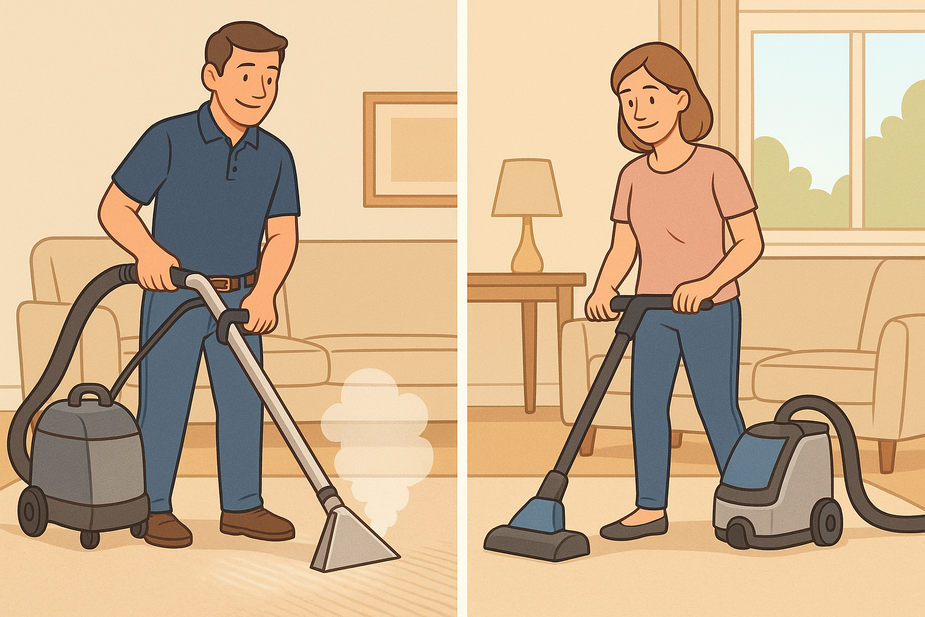
In the professional carpet cleaning industry, ‘steam cleaning’ is the everyday term used to describe a process formally called hot water extraction, or HWE. And despite what the name suggests, it is the hot water doing the work — not steam itself. HWE works by injecting hot water combined with a professional cleaning solution deep into carpet fibers under pressure, and then immediately extracting that water along with all the loosened soil, allergens, bacteria, and cleaning agents using powerful suction. The process can produce visible steam because of the heat involved, but true steam — the vapor — is not the cleaning agent. True vapor steam cleaning is a separate, distinct method primarily used on hard surfaces. When applied incorrectly to carpet fibers, high-temperature vapor can actually set certain stains or damage delicate materials. The professional equipment used to perform HWE — whether truck-mounted systems or high-grade portable commercial units — is what industry professionals refer to as steam carpet cleaners, even though the mechanism is hot water extraction.
Dry carpet cleaning, on the other hand, is not literally dry. That’s one of the most important things to understand about this method. The term refers to very low moisture (VLM) cleaning, not zero moisture. There are two main approaches used in professional settings. The first is dry compound cleaning, where an absorbent powder or solvent-based compound is applied to the carpet, worked into the fibers mechanically, allowed to absorb and trap dirt, and then vacuumed away along with the captured soil. The second is encapsulation cleaning, where a cleaning solution is applied and agitated into the fibers. As the solution dries, it crystallizes around soil particles — encapsulating them — and the crystallized residue is then removed by thorough vacuuming.
It’s important to understand that professional cleaners widely position dry and VLM methods as maintenance tools to be used between periodic deep hot water extraction cleanings, not as a complete substitute for them.
How Steam Cleaning (Hot Water Extraction) Really Works
Understanding the actual process behind hot water extraction helps explain why professional results look and feel so different from what a rental machine or surface spray can achieve.
A professional HWE cleaning follows a structured sequence. First, the technician performs a pre-inspection — examining the carpet to identify heavily soiled zones, stained areas, pet accident spots, and fiber type — followed by a thorough dry vacuum pass to remove loose surface soil before any moisture is introduced. Next comes pre-treatment, where a professional cleaning agent is applied to high-traffic lanes, pet accident areas, and stubborn stains to begin breaking down soils before the main cleaning pass.
Then the hot water extraction itself begins. The HWE machine — whether a truck-mounted system or a professional-grade portable unit — injects hot water combined with a cleaning solution under pressure directly into the carpet pile, flushing fibers all the way down toward the carpet backing. A cleaning wand, powered brush, or grooming tool follows to physically agitate and loosen embedded dirt, dander, bacteria, and residues. Immediately after, the same equipment uses high-powered suction to pull out the water, suspended soil, allergens, and cleaning agents — leaving the carpet deeply cleaned and only slightly damp.
The depth-of-clean advantage here is significant. HWE reaches embedded dirt and biological material that surface-level methods simply cannot access. Industry professionals consistently identify reduction of allergens, bacteria, and odors as a primary benefit of HWE over lighter cleaning approaches — and that benefit matters most in homes where health is a genuine priority.
On the topic of drying time: professionally performed HWE leaves carpets slightly damp, with typical drying times ranging from four to twelve hours depending on airflow, carpet thickness, and ambient humidity. Here’s where Denver Metro Area homeowners have a real advantage. The Front Range’s naturally low ambient humidity and strong seasonal air movement mean that professionally cleaned carpets dry faster here than the same job performed in a humid climate — particularly when homeowners open windows, run fans, or maintain airflow after the cleaning. The team at Carpet Couch Cleaning LLC accounts for this Colorado climate advantage when scheduling appointments, so clients are back to full use of their carpets as quickly as possible.
How Dry Carpet Cleaning Works — And Where It Genuinely Excels
Dry carpet cleaning has real, legitimate strengths, and understanding them clearly is the only way to make an informed decision. This method is not a compromise or a lesser option — it is genuinely the right choice for specific situations.
The dry/VLM cleaning process works as follows. First, a dry compound, absorbent foam, or encapsulating solution is evenly applied across the carpet surface. A brush machine or counter-rotating brush system then works the product down into the fibers so it makes full contact with and surrounds soil particles. For encapsulation methods, a short dwell period follows to allow the chemistry to crystallize around those particles, locking them in place for removal. Once the compound or encapsulated residue has completed its work, a thorough vacuuming removes it from the carpet along with all captured soil.
The dry carpet cleaning benefits that make this method genuinely valuable come down to a few core advantages. The most significant is minimal to zero downtime. Because very little moisture is introduced, carpets are walkable almost immediately after cleaning in most cases — making this method ideal when time is the primary constraint.
Dry cleaning also excels as a maintenance method. Used on a regular schedule between annual or periodic deep HWE cleanings, dry/VLM methods keep carpets looking clean and hygienic between deeper sessions — extending the lifespan and appearance of the carpet significantly. For commercial environments, offices, busy Airbnb properties, rental units, or any high-traffic space where carpets cannot be out of service for hours, dry cleaning’s near-zero drying delay makes it a practical, operationally sound choice. And for carpet types or backing materials where the manufacturer’s care guidelines specify very low moisture methods, dry cleaning is the appropriate fit — protecting both the fibers and any warranty coverage.
That said, honest framing matters here: dry cleaning has real limitations when carpets require deep restorative cleaning, heavy odor removal, or thorough allergen extraction. For those situations, it is not the primary tool of choice — and professional cleaners are clear about that distinction.
Steam Cleaning vs Dry Carpet Cleaning — The Direct Comparison
This is the section you came for. Here is how the two methods compare across the factors that matter most to homeowners making a real decision.
Depth of Clean
Hot water extraction penetrates deep into carpet fibers and reaches toward the carpet backing, flushing out embedded soils, pet residue, food spills, and long-standing contamination. For heavily soiled carpets or those with odor issues, this deep-reach capability is the defining advantage. Dry cleaning delivers consistently visible results — especially when maintenance cleaning is done on a regular schedule — and is highly effective at surface and mid-level soil removal. However, professionals generally position it as a maintenance method rather than the primary choice for severe contamination, deep-set odors, or carpets requiring restorative cleaning.
Drying Time
Professionally performed HWE leaves carpets slightly damp, with typical dry times of four to twelve hours. Improperly performed DIY hot water extraction using rental machines can leave carpets significantly wetter, extending that timeline considerably — but professional equipment with strong extraction power minimizes it. Dry cleaning’s very low moisture profile means carpets are walkable almost immediately, which is a clear practical advantage in time-sensitive situations. In Denver specifically, the low humidity and dry mountain air help HWE-cleaned carpets reach the lower end of the drying range, particularly when homeowners use fans and maintain good airflow — narrowing the drying time gap between the two methods more than in humid regions.
Stain and Odor Removal
The combination of heat, professional cleaning chemistry, and powerful extraction makes HWE the stronger choice for tough stains, pet accidents, food spills, and odor issues. Extraction removes contaminants rather than simply diluting or masking them. Dry cleaning handles light to moderate soiling and light spots effectively. However, deep odor sources — particularly pet urine that has reached the carpet padding or subfloor — are typically not fully addressed by VLM methods alone and often require HWE with additional subsurface treatment.
Allergen and Bacteria Removal
Industry sources consistently highlight reduction of allergens, bacteria, and odors as a primary benefit of hot water extraction, attributable to the heat of the cleaning solution combined with the thoroughness of the extraction process. For Denver Metro Area families with children, pets, or members who deal with allergies or asthma — particularly during Colorado’s significant spring pollen season or during wildfire smoke events that deposit fine particles indoors — periodic professional deep cleaning with HWE provides a meaningful reduction in indoor allergen load. Indoor air quality experts, including the U.S. Environmental Protection Agency, note that biological contaminants such as pet dander, dust mites, and mold spores are among the common indoor pollutants that can accumulate in carpets and soft furnishings and be re-released into the air when disturbed. You can review the EPA’s indoor air quality guidance at https://www.epa.gov/indoor-air-quality-iaq for further reading on this topic. Dry cleaning can reduce surface allergen load and deliver a noticeably cleaner environment, but is generally not the primary choice for households where maximum allergen removal is the health priority.
Carpet Safety and Fiber Suitability
When performed correctly by trained technicians using properly calibrated equipment, HWE is safe for most synthetic carpet fibers and many natural fiber carpets. Problems such as over-wetting, dye bleed, or fiber distortion are primarily associated with improper DIY use, underpowered equipment, or inadequate extraction — not with professional HWE executed correctly. Dry cleaning’s very low moisture profile makes it the gentler choice for delicate, moisture-sensitive, or specialty carpet types where manufacturer guidelines specify low-moisture methods. If you are unsure of your carpet’s fiber type or manufacturer care recommendations, consult a professional before choosing any cleaning method — that is exactly the kind of assessment the Carpet Couch Cleaning LLC team provides before every job.
Residue Concerns
Encapsulation compounds and dry cleaning products must be thoroughly vacuumed after treatment. Any compound or crystallized residue left behind in the fibers can act as a soil attractant, drawing new dirt back to the carpet more quickly. A properly performed hot water extraction cleaning includes a rinsing and extraction phase that removes loosened soil and the majority of the cleaning solution from the carpet, minimizing residue. Residue issues with HWE are typically the result of poor technique — excessive detergent use or inadequate rinsing and extraction — rather than the method itself when executed correctly.
So which is the best carpet cleaning method for your specific situation? The answer depends on your carpets, your household, and your priorities — and the next section makes that choice straightforward.
Which Carpet Cleaning Method Is Right for Your Home?
There is no single universal answer, and any professional who tells you otherwise is oversimplifying. The best carpet cleaning method is the one that matches your carpet type, your household’s specific needs, and your practical constraints. Here is an honest, scenario-based guide to help you decide.
Choose steam cleaning — hot water extraction — if you have pets and are dealing with recurring accidents, urine odors, pet dander, or staining. HWE’s ability to flush and extract deep odor-causing residue from the carpet pile and backing makes it the appropriate choice for pet households. Think of a family with two dogs who notice a persistent odor returning every time the weather turns warm — that’s a subsurface contamination issue that only thorough extraction can resolve.
Choose HWE if you have young children who play on the floor, or family members with allergies or asthma. Deeper removal of allergens, bacteria, and biological contaminants is a health priority, particularly during Colorado’s intense spring allergy season or during periods of elevated wildfire smoke.
Choose HWE if your carpets have not been professionally cleaned in over a year, or show visible wear lanes, heavy traffic soiling, or stubborn stains that have not responded to surface cleaning. This is also the right call when you are preparing for a move-out inspection, a move-in, a home sale, or a real estate listing — carpets need to look, smell, and perform at their best.
Landlords, Airbnb hosts, and property managers turning over a rental unit between tenants will almost always benefit from a full hot water extraction cleaning before bringing in new occupants.
Choose dry cleaning if your carpets are lightly soiled and you simply need a quick refresh or interim clean between deeper annual appointments. Choose it if you need carpets ready to use almost immediately — a busy short-term rental with a tight guest turnaround, a home office that cannot be off-limits for half a day, or a commercial space with constant foot traffic. The dry carpet cleaning benefits of minimal downtime and fast return to use are real advantages in these scenarios. Dry cleaning is also the right choice if you have moisture-sensitive carpet materials or manufacturer guidelines that specify very low moisture methods. You can also learn how often to clean carpets for the best results.
When you are genuinely unsure — whether about your carpet fiber type, your soiling level, or which method fits your household — a professional assessment will always give you a more accurate answer than guesswork. That is precisely what the Carpet Couch Cleaning LLC team does for Denver Metro Area homeowners: inspect the carpet, discuss your household’s specific concerns, and recommend the approach that actually fits.
Why Professional Carpet Cleaning Delivers Results That Rental Machines Can’t Match
Let’s be honest about something: rental carpet cleaning machines exist, many homeowners have tried them, and sometimes they provide a noticeable short-term improvement. There is nothing wrong with having tried one. But there is a meaningful technical difference between what a rental unit can do and what professional equipment delivers — and understanding it helps explain why professional results last longer and go deeper.
Professional HWE systems — including truck-mounted units and high-grade portable commercial machines — operate at significantly higher water pressure and far stronger vacuum extraction capacity than any consumer or rental unit you can bring home from the hardware store. That difference in extraction power is the central factor. Stronger extraction means more soil is removed, more cleaning solution is rinsed out of the fibers, and less moisture remains in the carpet after cleaning. The result is a genuinely cleaner carpet that dries faster and carries less risk of problems down the line.
Consumer and rental steam carpet cleaners typically operate at a fraction of the pressure and suction capacity of professional equipment. That means they often leave more moisture in the carpet and extract less of the soil and detergent they introduce. Over-wetting is one of the most common problems that follows DIY hot water extraction. When too much moisture is introduced and not adequately pulled back out, it can reach the carpet padding and even the subfloor — creating conditions that prolong drying significantly, invite musty odors, and in worst cases, support mold or mildew growth beneath the carpet surface. A homeowner who steam-cleans their own carpets and notices them smelling musty a few days later has likely encountered exactly this problem.
Beyond equipment, professional technicians bring trained expertise that changes the outcome of every cleaning. A trained technician correctly identifies carpet fiber type and condition before selecting pre-treatment chemistry and cleaning approach. They adjust products and dwell times based on the specific type of soiling — pet urine, grease, and food stains each require different chemistry. They calibrate water volume, agitation technique, and extraction passes to achieve deep cleaning without over-wetting or damaging fibers. And they recognize when additional treatments — such as subsurface pet odor neutralization or fiber protection application — are needed and know how to apply them correctly.
Rental machines are adequate for very small touch-up jobs. For whole-home cleaning, stubborn stains, pet contamination, or any situation where carpet hygiene genuinely matters, professional-grade equipment combined with trained expertise produces a fundamentally different and safer result — and it also protects carpet warranties while extending the useful life of your flooring investment.
The Carpet Couch Cleaning LLC Approach: Honest Recommendations, Professional Results
We want to be straightforward with you about how we approach the steam cleaning vs dry carpet cleaning question in our own work — because we think you deserve a transparent answer, not a sales pitch.
For the majority of residential jobs we take on in the Denver Metro Area, we lead with hot water extraction. The reason is simple: for most homes — particularly those with pets, children, or occupants who deal with allergies or asthma — HWE delivers the depth of clean, the allergen removal, and the odor elimination that genuinely reflects our core philosophy of ‘Clean home, healthy life.’ It also aligns with the cleaning approach that many carpet manufacturers recommend for periodic professional maintenance, which means it protects your carpet investment alongside your family’s health. Many professional cleaning industry sources position HWE as the gold standard for restorative residential carpet cleaning, and some recommend pairing it with encapsulation or VLM maintenance cleanings in between — an approach we find genuinely effective for clients who want to maintain their carpets at a high level year-round.
That said, we are equally committed to using dry and VLM methods when they are the right fit. For maintenance visits between annual deep cleans, quick-turnaround rental properties, Airbnb units with back-to-back guests, or lightly soiled carpets that primarily need a refresh, dry and encapsulation methods are smart, practical, and effective tools. Carpet Couch Cleaning LLC uses the method that fits your actual situation — not a one-size-fits-all default that serves our schedule better than your carpet.
We use professional cleaning solutions that are eco-friendly and safe for children and pets — because the families and households we serve in Arvada and across the Denver Metro Area care deeply about what goes into their homes, and so do we. Our equipment is modern, high-powered, and designed for thorough extraction that minimizes drying times, reduces any risk of over-wetting, and protects carpet fibers and backing over the long term.
Every assessment we perform is client-first. We look at carpet fiber type, soiling level, fiber sensitivity, household health concerns, and scheduling needs before making any recommendation. Our goal is always to recommend the right approach for you — not the easiest approach for us. That commitment to honest, individualized assessment is what we believe makes the difference between a cleaning service and a cleaning partner.
We also bring specific local knowledge that matters for Colorado homes. Based in Arvada and serving the entire Denver Metro Area, our team understands the real carpet care challenges that Front Range homes face: tracked-in winter soils and road salt, intense spring allergy seasons, the dry climate’s effect on carpet fibers and drying times, and the fine particles from wildfire smoke that settle into soft furnishings and carpets over time. That local context shapes how we clean and what we recommend — and it’s a perspective you simply don’t get from a national franchise unfamiliar with Colorado conditions.
Beyond carpet cleaning, Carpet Couch Cleaning LLC also serves Denver Metro Area homeowners, renters, landlords, Airbnb hosts, and real estate professionals with professional upholstery cleaning and rug cleaning — all delivered with the same commitment to safe, effective, eco-friendly results. Whatever you need cleaned in your home, we bring the same care and expertise to every job.
Whatever your carpet’s condition or your household’s specific priorities, the Carpet Couch Cleaning LLC team is here to assess, advise, and deliver — with no guesswork required on your part.
Ready to Get Your Denver Metro Area Carpets Professionally Cleaned?
Here’s the bottom line: both methods have a legitimate, well-defined role in professional carpet care. For most Denver Metro Area homes, professional hot water extraction is the go-to approach for deep, restorative cleaning — delivering the thorough allergen removal, stain and odor elimination, and long-term carpet health that defines a genuinely clean home. Dry and VLM cleaning methods are a smart, convenient solution for maintenance visits, quick-turnaround situations, and moisture-sensitive materials. The steam cleaning vs dry carpet cleaning decision does not need to be complicated — it just needs to be matched to your specific home and situation.
You do not need to figure that out alone. The team at Carpet Couch Cleaning LLC will assess your carpets, listen to your household’s specific concerns, and recommend exactly the right approach — whether that’s a deep hot water extraction clean, a maintenance dry clean, or a combination of both for the best carpet cleaning method outcome over time.
If you’re heading into spring, now is the ideal time to remove the winter soils, road salt, and allergens that have accumulated in your carpets over the colder months — before Front Range pollen season adds to the load. And if wildfire smoke season is approaching or you’re preparing for holiday guests, there is no better time to start fresh with carpets that are truly, deeply clean.
Scheduling is fast and straightforward. Reach out to Carpet Couch Cleaning LLC today to request a free quote or book your professional cleaning. Our team uses eco-friendly, pet-safe solutions and modern professional equipment to deliver results you can see, smell, and feel — and we serve homeowners, renters, landlords, Airbnb hosts, and real estate professionals throughout Arvada and the entire Denver Metro Area. Getting in touch is easy — and having genuinely clean, healthy carpets is absolutely worth it.