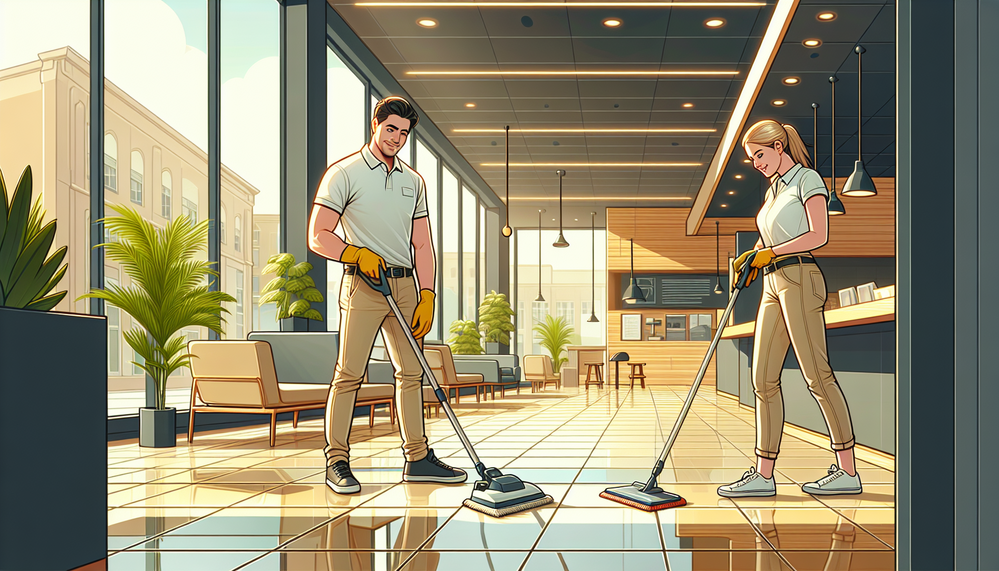
Picture this: a prospective client steps into your Denver office lobby for the first time. Before you shake hands or say a word, their eyes drop to the floor. The tile is dull. The grout lines are visibly darkened and streaked. In that moment — before a single word is spoken — an impression has already formed. According to research from the International Facility Management Association (IFMA), 80% of commercial visitors form opinions about a business’s professionalism within the first 10 seconds, and flooring condition is consistently cited as one of the top contributing factors. The same dynamic plays out in restaurant dining rooms, retail showrooms, and office corridors across the Denver Metro Area every single day.
Commercial tile is engineered for durability. It can withstand heavy foot traffic, spills, and years of use. But durability is not the same as self-maintaining. Tile surfaces endure — grout lines do not, not without professional intervention. That is where commercial tile cleaning Denver becomes not just a maintenance option, but a business-critical necessity. Carpet Couch Cleaning LLC is the Denver Metro Area’s local expert in professional commercial tile and grout cleaning, serving offices, restaurants, and retail operations across the Front Range. This post covers why commercial tile degrades faster than most business owners expect, which spaces carry the highest risk, what professional cleaning actually involves, and how to take the next step toward floors that work for your business — not against it.
Why Commercial Tile Gets Dirtier Than You Think
Most facility managers understand that commercial tile needs cleaning. Fewer understand the scale of the problem happening below the surface. Commercial environments experience 10 to 50 times more daily foot traffic than residential spaces — and every pass across that floor carries grit, moisture, oils, and seasonal contaminants that accumulate in ways a standard mop simply cannot address. In Denver specifically, the problem intensifies during winter months. Road salt and snowmelt tracked in from Colorado’s front range roads don’t just sit on the tile surface — they are ground into grout lines with every footstep.
The EPA has documented that tracked-in pollutants like road salt and particulate matter increase PM2.5 levels in high-traffic commercial entries by 200 to 300%, worsening indoor air quality and accelerating the degradation of floor surfaces. According to the Tile Council of North America (TCNA), grout is a porous material capable of absorbing up to 20% of its weight in moisture and oils. This means bacteria, grease, and soils penetrate deep below the visible surface — far beyond where any standard mop can reach. Routine mopping does not solve this problem. The IICRC S710 Standard for Hardfloor Maintenance confirms that janitorial mopping actually spreads emulsified soils further into grout lines over time, progressively darkening them and increasing microbial load.
This is the critical distinction every commercial facility manager needs to understand: routine maintenance cleaning — daily sweeping, weekly mopping — is necessary for surface hygiene and appearance management. Professional deep cleaning is an entirely different service. It is periodic, equipment-driven, and the only method that reverses embedded soil buildup in tile and grout. Commercial tile cleaning Denver refers specifically to this professional-grade intervention, not the cleaning your janitorial team already handles. Both serve important roles; only one restores the floor.
The Three Commercial Spaces That Need Professional Tile Cleaning Most
Not all commercial tile environments carry equal risk. Three types of commercial spaces consistently face the most severe tile and grout challenges — and each one presents distinct concerns that business owners and facility managers need to address proactively.
Office Lobbies and Common Areas — Office Grout Cleaning
Office lobbies represent the first physical touchpoint for clients, vendors, and prospective employees. Mid-sized Denver office buildings see 500 or more daily visitors, according to IFMA benchmarking data, leading to 30% faster grout discoloration compared to lower-traffic spaces. Polished lobby tile gradually loses its finish as grit and road salt work into the grout surface, making even a thoughtfully designed entryway look neglected and unprofessional over time.
Office grout cleaning extends well beyond the lobby, however. High-traffic corridors, employee break rooms, and restroom tile throughout office buildings accumulate the same embedded soils and require the same professional intervention. This is not simply a cosmetic concern. A visibly dirty, discolored lobby floor communicates neglect to every person who walks through the door — whether that person is a client evaluating your business, a candidate considering a job offer, or a vendor assessing whether this is an organization worth partnering with. Facility managers who invest in professional office grout cleaning are making a direct investment in how their organization is perceived. The IICRC recommends professional office grout cleaning at least every three to six months for high-traffic commercial spaces to maintain both indoor air quality standards and visual presentation.
Restaurants and Commercial Kitchens — Restaurant Tile Cleaning
No commercial environment subjects tile and grout to more aggressive contamination than a restaurant or commercial kitchen. The National Restaurant Association reports that commercial kitchens accumulate five to ten pounds of grease and food debris per 1,000 square feet every single week. That volume of contamination does not stay on the surface of the tile — it penetrates grout lines continuously throughout daily operations.
The consequences go far beyond appearance. According to CDC food safety guidelines, grout can harbor dangerous bacteria including Listeria and Salmonella when not professionally cleaned, creating a genuine food safety liability for any food service operation. Colorado’s regulatory environment takes this seriously: the Colorado Department of Public Health and Environment mandates sanitation standards for tile floors in food service settings. Restaurant tile cleaning is not a cosmetic preference in this context — it is a compliance requirement. Beyond the kitchen, front-of-house dining tile and restaurant entryways also accumulate grime that directly impacts the guest experience. The EPA also notes that high humidity in kitchen environments fosters mold growth in grout, adding a further layer of health risk that standard mopping cannot address.
Retail Stores — Retail Floor Tile Service
Retail floors endure continuous, high-volume foot traffic across large surface areas — often without proportionate cleaning attention relative to the scale of the problem. According to Retail Industry Leaders Association data, peak shopping periods like Colorado’s holiday season can increase foot traffic by up to 300%. That surge in traffic deposits an enormous volume of grit, moisture, and contaminants into tile and grout in a compressed timeframe.
Dull, streaky, or stained tile in a retail environment communicates neglect to shoppers and undermines the brand experience the business has worked to build, even when every other element of the store is carefully maintained. There is also a significant safety dimension. OSHA has identified slippery tile floors as one of the top causes of slip-and-fall incidents in commercial settings, logging over 95,000 injuries annually. In a retail context, this represents both a safety issue and a substantial liability exposure. A professional retail floor tile service addresses both concerns simultaneously — restoring appearance and eliminating the grease and soil buildup that creates slip hazards. Scheduling is also designed around the business: professional cleaning is planned for off-hours, early mornings, evenings, or between seasons, to minimize any disruption to customer-facing operations.
What Professional Commercial Tile Cleaning Actually Involves
Understanding what separates professional cleaning from routine maintenance helps commercial decision-makers assess the value of the investment accurately. The process Carpet Couch Cleaning LLC follows is aligned with IICRC S710 standards and structured to deliver thorough, lasting results — not a surface treatment that fades within weeks.
The process begins with a pre-inspection. A professional technician assesses tile type — porcelain versus ceramic, glazed versus unglazed — grout condition, staining severity, and total surface area. This step ensures the correct cleaning agents and equipment are selected for the specific floor in front of them. There is no one-size-fits-all approach in professional commercial tile cleaning.
Next, professional-grade cleaning solutions are applied. Carpet Couch Cleaning LLC uses EPA Safer Choice-certified solutions formulated to be non-toxic and safe for occupied commercial spaces — delivering commercial-strength cleaning power while protecting employees, customers, and the surrounding environment.
Following application, technicians deploy high-pressure hot water extraction operating at 150 to 200 PSI, specialized rotary scrubbing equipment, or a combination of both, depending on the surface type and contamination level. The Carpet and Rug Institute confirms this method removes 98% or more of embedded soils. The IICRC also notes that professional-grade vapor steam cleaning kills 99.9% of bacteria on tile and grout surfaces — a benchmark no standard in-house janitorial equipment can reach.
Grout-specific cleaning tools are then used — narrow, high-pressure heads designed to reach deep into porous grout channels and extract the oils, bacteria, and soils that have penetrated below the surface. These are not the wide floor heads used on general autoscrubbers. They are precision instruments built for the specific geometry of commercial grout lines.
Once loosened, all soils and residue are fully extracted and removed from the space entirely. The floor is left genuinely clean — not redistributed with displaced grime. Finally, following the deep clean, Carpet Couch Cleaning LLC offers penetrating grout sealers that, according to TCNA data, extend the life of cleaned grout by two to three times and reduce the frequency of future professional cleaning intervals. The IICRC confirms that sealing can extend required cleaning intervals by 50 to 100%, protecting the business’s investment between professional visits. Because the process uses eco-friendly, non-toxic solutions throughout, the space is ready to return to full operations quickly — a critical factor for any business that cannot afford extended downtime.
The Real Cost of Neglecting Your Commercial Tile
Framing professional tile cleaning purely as an expense misses the larger financial picture. The TCNA reports that untreated, neglected grout fails structurally within two to five years, compared to ten or more years with proper maintenance. Grout replacement costs $10 to $20 per square foot — a cost that can reach tens of thousands of dollars for a mid-sized commercial space, far exceeding the cumulative cost of regular professional cleaning over the same period.
The liability exposure is equally significant. OSHA records approximately 95,000 commercial slip-and-fall injuries annually from greasy or degraded tile surfaces, with an average workers’ compensation or liability claim of $30,000. For any Denver business, this risk far outweighs the cost of professional tile maintenance. In restaurant tile cleaning environments specifically, grease-coated kitchen floors are among the highest-risk surfaces OSHA has identified — making this not just a financial issue, but a direct operational and legal concern.
Beyond structural failure and liability, dirty tile and grout carry operational consequences. In Colorado’s food service industry, a failed health inspection citation can interrupt operations, damage reputation, and result in fines. EPA indoor air quality research links visibly dirty commercial floors to a 20 to 30% increase in staff absenteeism. Independent review analysis shows that ‘dirty floors’ appear in approximately 15% of one-star business reviews. CDC workplace hygiene data connects clean commercial environments to measurably better staff morale and productivity — factors that affect retention and operational performance well beyond aesthetics. The cost of neglect is not hypothetical. It is documented, quantifiable, and avoidable.
How Often Should Denver Businesses Schedule Professional Tile Cleaning?
The right cleaning frequency depends on the type of commercial space, traffic volume, and operational conditions — not a generic calendar. Based on IICRC S710 standards and CRI guidance, here is what the data recommends for Denver’s primary commercial environments.
Restaurants and commercial kitchens should schedule professional tile cleaning quarterly at minimum. High-volume operations — where grease accumulates at four times the rate of lower-activity kitchens — should consider monthly professional service to stay ahead of both contamination and compliance risk.
Office lobbies, corridors, and restrooms require professional office grout cleaning every three to six months, adjusted for building size and daily foot traffic volume. A 200-person office with a high-traffic entryway has meaningfully different needs than a smaller professional suite, and the cleaning schedule should reflect that difference.
Retail floors should be cleaned bi-annually or aligned to Colorado’s seasonal peaks — scheduled before the holiday traffic surge and again after winter to address the accumulated road salt and moisture damage that Front Range winters consistently deposit on commercial tile.
In all three cases, professional grout sealing following each clean can extend the interval between services by 50 to 100%, according to IICRC data. At Carpet Couch Cleaning LLC, the team does not apply a uniform schedule to every commercial client. Each space is assessed individually, and a maintenance plan is recommended based on that business’s specific traffic patterns, tile type, and operational requirements.
The Carpet Couch Cleaning LLC Approach to Commercial Tile Cleaning in Denver
Carpet Couch Cleaning LLC is a Denver Metro Area-based professional cleaning company with direct, hands-on experience serving commercial tile environments across the Front Range — from Arvada offices to downtown Denver restaurant kitchens and across the full range of Colorado’s commercial real estate. The team understands the specific challenges that Colorado businesses face that many general cleaning companies do not: winter road salt, rapid snowmelt moisture, and the accelerated grime accumulation that characterizes high-traffic commercial spaces in this region. That local knowledge shapes every assessment and every cleaning plan.
The company’s technicians follow IICRC-aligned cleaning standards and operate professional-grade equipment — including high-pressure hot water extraction systems and rotary grout-specific tools — that deliver results no in-house janitorial team can replicate. The approach is disciplined, process-driven, and backed by industry standards, not improvised on-site.
All cleaning solutions used are non-toxic, EPA Safer Choice-certified products that are safe for the employees, customers, and guests who occupy the space — and that align with Colorado’s commitment to environmental responsibility. Commercial-strength cleaning does not require exposing staff or the public to harsh chemical residues. The right chemistry, applied correctly with the right equipment, achieves both outcomes simultaneously.
Flexible scheduling is built into the service model. The team offers early morning, evening, and weekend appointments specifically designed to work around the operational hours of Denver businesses. IFMA benchmarking confirms that 90% of commercial facilities prefer off-hours cleaning services — a preference Carpet Couch Cleaning LLC is structured to accommodate without exception.
Commercial clients receive clear, upfront pricing with no hidden fees. Facility managers and business owners can budget with confidence and plan cleaning schedules without uncertainty. The approach to commercial tile cleaning Denver is built on a straightforward commitment: visible, lasting results — not a surface treatment that masks the problem until the next mopping cycle.
Get a Free Commercial Tile Cleaning Quote from Carpet Couch Cleaning LLC
Denver’s commercial tile floors — in offices, restaurants, and retail stores — take a significant beating from daily traffic, Colorado winters, and the demands of ongoing business operations. Professional deep cleaning is the only method that truly restores and protects them. Every commercial space is different. A restaurant kitchen in Denver’s RiNo district has different contamination challenges than a corporate office lobby in Arvada or a retail floor tile service project for a large-format retail store in the suburbs. The best starting point is always a direct conversation with a professional who understands those differences and can assess your space with that context.
Contact Carpet Couch Cleaning LLC today for a free, no-obligation commercial tile cleaning assessment tailored to your business’s space, tile type, and scheduling requirements. The team proudly serves businesses across the entire Denver Metro Area, from Arvada to downtown Denver and throughout the Front Range. If your operation would benefit from a recurring professional cleaning schedule — so your floors are maintained year-round without you having to manage the timing and logistics — the team is also ready to design a maintenance plan built around your business calendar. Clean floors are not just an aesthetic decision. They are a business decision. Let Carpet Couch Cleaning LLC help you make the right one.