If you have ever walked into your living room and immediately known — before you even looked down — that your pet had an accident on the carpet, you already understand why so many Denver-area homeowners feel frustrated when they try to remove pet stains from carpet and the problem keeps coming back. That sharp, unmistakable odor. The discolored spot you thought you had already cleaned twice. The sinking feeling that no matter what you try, it just never fully goes away.
First, let this be said clearly: pets are family. This is not a post that judges anyone for having a dog who had an off day or a cat who decided the carpet looked more appealing than the litter box. Every pet owner deals with this, even the most diligent ones. It is one of the most common and most stubborn household challenges that homeowners face, and it deserves a real, honest answer rather than a list of quick fixes that do not actually work.
Here in the Denver Metro Area, this problem has an extra layer. Colorado winters are long and cold, and during those months, homes are sealed tight with heating systems running around the clock. That warm, closed-up environment is exactly where pet odors concentrate, circulate, and become impossible to ignore. Your nose adjusts when you live there every day, but visitors notice it immediately — and if you are a renter, a landlord, or an Airbnb host, that matters enormously.
By the time you finish reading this post, you will understand exactly why pet stains are so difficult to eliminate, what steps to take the moment an accident happens, which DIY methods are worth trying and which ones fall short, what professional pet urine carpet cleaning actually involves, and how to break the cycle so the problem does not keep coming back. That knowledge will help you make the smartest possible decision for your home, your family, and your pets.
Why Pet Stains and Odors Are So Difficult to Eliminate
Most people assume that a pet stain is basically like any other liquid spill on carpet — wet it, blot it, treat it, done. The reason that assumption leads to so much frustration is that pet urine is chemically far more complex than a coffee spill or a glass of juice, and its behavior in carpet is fundamentally different from almost any other household stain.
When urine first lands on carpet, it is an acidic liquid. As it begins to dry, it undergoes a chemical shift, becoming increasingly alkaline and forming urea salts. These salts create a moist, bacteria-friendly environment within the carpet fibers that generates odor as organic decomposition continues. The bacteria feeding on the urine residues produce ammonia gas and other volatile organic compounds — this is the sharp, persistent smell that is so recognizable in homes with pets and so difficult to cover up.
But here is the deeper problem: the urine does not stay in the fibers you can see. The moment it hits the carpet, gravity and capillary action begin pulling it downward. It soaks through the carpet fiber layer, then through the carpet backing, and then into the carpet pad underneath. In older carpets, heavily saturated areas, or situations where accidents have happened repeatedly in the same spot, the contamination can even reach the subfloor beneath the pad. This downward migration happens quickly — within minutes of an accident occurring.
This is the core reason why surface cleaning almost never solves the problem completely. When you spray a cleaner on top of the carpet and blot it up, or when you run a consumer rental machine over the area, you are treating a fraction of the contamination zone. The majority of the urine — along with the urea salts and bacteria it has deposited — is sitting below in the pad, entirely undisturbed by whatever you applied to the surface.
As the urine dries out completely, it leaves behind uric acid crystals embedded throughout those lower layers. These crystals have a particular behavior that explains one of the most frustrating experiences pet owners describe: you clean an area thoroughly, the smell disappears for a while, and then weeks or months later it comes back seemingly out of nowhere. What actually happened is that the uric acid crystals became dormant when the air was dry, making them largely odorless. Then, when humidity rose — during a spring storm, after running a humidifier, in a damp basement — those crystals absorbed moisture, reactivated, and began releasing their odor again.
This cycle is exactly why effective carpet odor removal is so much harder than it first appears, and why Denver-area homeowners are especially vulnerable to it. Colorado’s spring brings significant humidity spikes with seasonal storms, and basements and lower-level carpeted spaces in metro area homes can maintain elevated moisture levels for weeks at a time. Add the concentrated indoor air of a sealed, heated home during a Colorado winter, and old uric acid crystals have exactly the conditions they need to make their presence known again and again.
What to Do the Moment a Pet Accident Happens
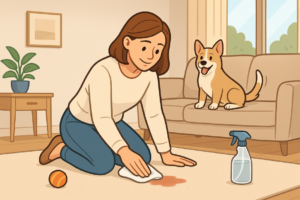
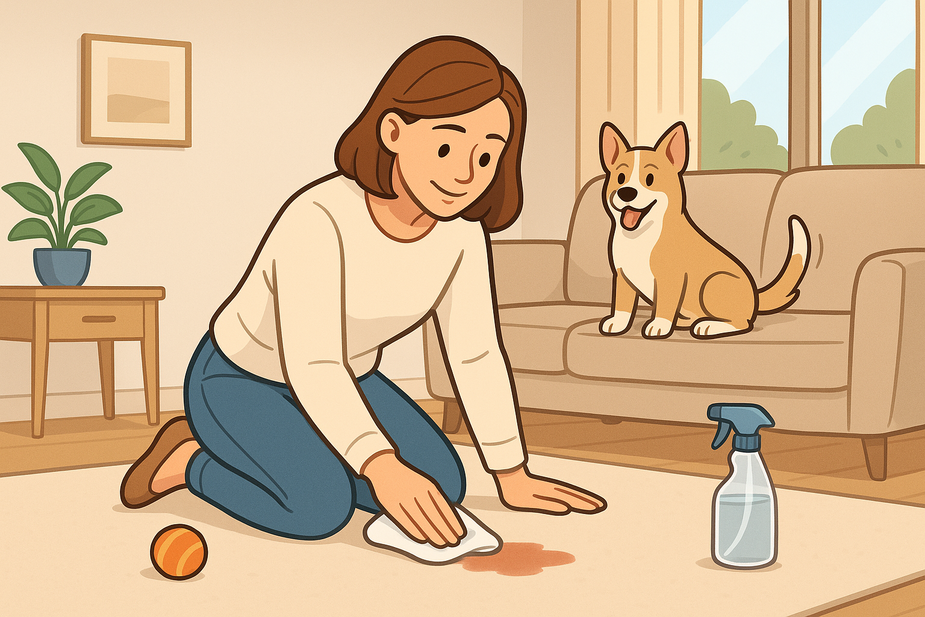
Speed is the single most important factor in managing a fresh pet accident. The faster you respond, the less time the urine has to spread sideways across the carpet and penetrate downward into the backing and pad. Acting within the first few minutes genuinely changes the outcome — it does not guarantee perfection, but it is the difference between a manageable situation and a deeply embedded problem.
Step 1: Act immediately. Do not finish what you were doing first. Every minute that passes allows the urine to spread further into the carpet structure. Grab clean white towels or paper towels and get to the area right away.
Step 2: Blot — never rub. Place the towels directly over the stain and press firmly down to absorb as much liquid as possible. Lift and replace with fresh sections of towel as they become saturated. Never scrub, wipe, or rub the area. Rubbing spreads the contamination outward, enlarges the affected zone, forces liquid deeper into the fibers, and physically distorts the carpet pile in a way that can cause permanent damage.
Step 3: Use cool or lukewarm water only. Heat can permanently set stains and odors into carpet fibers and dyes. After your initial blotting, lightly rinsing the area with cool water and blotting again can help dilute and lift additional urine. This is not the time for hot water, steam, or a hot-water extraction machine used by a homeowner — heat applied at this stage can make the stain and odor permanently worse.
Step 4: Extract as much moisture as possible. If you have a wet/dry shop vacuum or a small spot extractor, use it after blotting. These tools can pull up additional liquid from the fibers that towels simply cannot reach. The more liquid you remove before it dries, the less contamination will settle into the backing and pad below.
Step 5: Apply a pet-specific enzymatic cleaner. Once you have blotted the area as dry as you reasonably can, apply a quality enzymatic cleaner generously to the affected area — generously enough that the product can actually reach into the fiber layers where urine has traveled. Follow the label’s dwell-time instructions carefully. Enzymatic cleaners contain biological enzymes that begin breaking down the organic components of fresh urine before they have the chance to dry and crystallize into the harder-to-treat form. For fresh accidents, this is by far the most effective product you can reach for.
Even a perfect first response, however, cannot fully guarantee that no residues have reached the pad below — especially if the accident was large, if the carpet is thick, or if there was any delay before you got to it. That is where the limitations of DIY treatment become directly relevant.
DIY Stain Removal Methods: What Works, What Doesn’t
Most pet owners reach for household remedies before anything else, and that is entirely understandable. Some of these methods do have a legitimate role in managing minor, fresh accidents, and it is worth knowing what each one can and cannot do.
Baking Soda and White Vinegar
This is one of the most widely shared home remedies for pet stain treatment, and it is not completely without merit. Baking soda can help deodorize surface fibers and absorb residual moisture after blotting. Diluted white vinegar can help neutralize some of the acidic components of very fresh urine.
The honest limitations, though, are significant. This approach affects only the uppermost carpet fiber layer — it has essentially no ability to penetrate into the backing or pad where the majority of the urine contamination may have already settled. Baking soda, if not vacuumed out thoroughly after it has done its work, can leave behind a powdery residue that attracts additional soil over time. Most importantly, baking soda and vinegar do not dissolve or neutralize deep uric acid crystals, meaning any carpet odor removal achieved by this method is likely to be temporary. The odor may seem gone initially, only to return the next time humidity rises.
Hydrogen Peroxide Mixtures
A mild 3% hydrogen peroxide solution can lighten some organic stains and has a mild antibacterial effect on surface contamination. This sounds promising, but it comes with serious risks that must be taken seriously.
Hydrogen peroxide can bleach or permanently discolor carpet dyes, particularly on wool, nylon, or any carpet with vibrant or dark colors. Leaving it on too long or applying too much can also weaken carpet fibers, creating light, uneven spots that cannot be reversed. If you ever choose to try this method, you must first spot-test it in a completely hidden area of the carpet and proceed with extreme caution. On colored or patterned carpet, this method carries a high risk of causing permanent cosmetic damage that may be more visible than the original stain.
Store-Bought Enzymatic Cleaners
Of all the DIY options available, store-bought enzymatic cleaners are the most promising by a meaningful margin. These products contain biological enzymes that work as catalysts to break down the organic matter in urine, including urea proteins and uric acid compounds — essentially digesting the source of the odor at a chemical level rather than simply masking it with fragrance.
They work best when applied generously enough to actually reach the full depth of the affected fibers, given the full dwell time specified on the label, and used on fresh accidents rather than old, dried stains. For a minor, fresh accident that was caught quickly and properly blotted beforehand, a quality enzymatic cleaner used correctly can manage the situation quite effectively.
The limitation is one of concentration and penetrating power. Consumer-grade enzymatic cleaners are significantly less concentrated than professional-grade formulations. For any accident that has had time to dry and crystallize, for repeat-offender spots that have been treated multiple times, or for contamination that has saturated the pad, consumer enzymatic products typically cannot deliver the volume or penetrating power needed to address the full scope of the contamination.
For fresh, minor accidents caught immediately, the DIY methods above can help manage the situation. But for older stains, chronic problem areas, or odors that keep returning no matter what is applied, these methods are fundamentally limited by a straightforward physical constraint: they cannot fully reach, saturate, and extract contaminants from the backing, the pad, and the subfloor beneath. That requires a different level of equipment and product entirely.
Finding the Best Carpet Cleaner for Pets: Consumer Machines vs. Professional Equipment
When pet owners ask what the best carpet cleaner for pets actually is, it is a fair and important question that deserves a genuinely honest answer — not a dismissal of every consumer option, but a clear-eyed comparison based on how each type of equipment actually performs.
Consumer and Rental Carpet Cleaning Machines
Portable consumer carpet cleaning machines and rental units from hardware stores have real value in the right context. They are convenient, relatively affordable, and can refresh the surface appearance of carpets and address light soils and mild odors between professional visits. For routine carpet maintenance in a pet household, they have a place.
Their limitations become critical, however, when pet urine is involved. Consumer machines operate at significantly lower water temperatures and pressures than professional truck-mounted equipment. This limits their ability to penetrate into the lower carpet layers where urine residues and bacteria actually reside. Their extraction power — the vacuum suction that removes water and contaminants from the carpet — is also substantially weaker than professional systems.
This combination creates a specific, frustrating problem for pet urine situations: because consumer machines cannot fully extract the water and cleaning solution they introduce, they often leave the carpet over-wetted. When a carpet is over-wetted and begins to dry, contamination from the pad and lower layers can migrate back upward through the fibers via capillary action, depositing stain and odor residues back at the surface as the carpet dries. This is called wicking, and it is why homeowners sometimes find that a spot looks clean immediately after using a rental machine but looks worse a day or two later after the carpet has fully dried.
Professional-Grade Hot Water Extraction — What ‘Steam Cleaning’ Really Means
Hot water extraction — commonly called steam cleaning, though that term is technically imprecise — is the process of injecting a combination of hot water and professional cleaning solution deep into carpet fibers at high pressure, then immediately extracting that water along with dissolved dirt, urine residues, bacteria, urea salts, and cleaning agents using powerful vacuum suction. The combination of heat, pressure, and extraction power reaches into the carpet backing and works into the pad in ways that consumer machines simply cannot replicate.
Professional truck-mounted systems operate at significantly higher water temperatures, greater injection pressure, and far more powerful extraction than any consumer or rental unit. This is not a marginal difference — it is a categorical one. The results reflect it.
Professional cleaners also use industrial-strength enzymatic treatments specifically formulated for pet urine contamination, often combined with oxidizers and odor encapsulants that work at the molecular level to destroy uric acid crystals rather than mask them. These formulations are not available on store shelves.
An important reassurance for families with pets and children: reputable professional cleaning companies use eco-friendly, pet-safe cleaning solutions designed to minimize chemical residues in the carpet after the work is complete. Professional cleaning with the right products is safe for dogs, cats, and children once the carpet has dried — and in many cases is significantly safer than a homeowner repeatedly applying a mixture of random household chemicals to the same area of carpet over months or years.
When the question is what the best carpet cleaner for pets truly is, the evidence leads to a clear answer for anything beyond routine light maintenance: professional-grade hot water extraction delivers results that consumer options cannot match, especially for pet urine, repeat stains, and persistent carpet odor removal challenges.
How Professional Pet Urine Carpet Cleaning Works — Step by Step
Understanding what professional pet urine carpet cleaning actually involves makes the decision to book it far less mysterious. It is a thorough, multi-step process — not a single pass with a machine. Here is what a professional service should look like.
Step 1 — Inspection and UV Light Detection
A proper professional cleaning begins before any water or cleaning product is introduced. Technicians use UV black lights to identify every contaminated area on the carpet, including spots that are completely invisible under normal lighting. Most homeowners are genuinely surprised at what a UV inspection reveals — what looks like a small, isolated stain on the surface may indicate a contamination zone several times larger beneath in the pad, because urine spreads laterally as it soaks downward. Mapping the full contamination area before treatment begins ensures no affected zones are missed. Some technicians also use moisture meters to gauge the depth and spread of the contamination.
Step 2 — Pre-Treatment with Enzyme and Oxidizing Solutions
Before any water is introduced, a professional applies a concentrated, pet-safe enzymatic solution — often combined with oxidizers and odor encapsulants — directly and generously to all affected areas. This solution is applied with enough volume to penetrate from the surface fibers down through the backing and into the pad. It then dwells for a set period, giving the enzymes time to begin breaking down urine proteins, urea, and uric acid at the source, and allowing oxidizers to work on odor-causing bacteria at the same time.
Step 3 — Subsurface Extraction for Severe Contamination
For heavily contaminated areas or situations where pet accidents have occurred repeatedly in the same location, professionals use specialized subsurface extraction tools — such as a water claw or similar device — that create a sealed suction chamber directly in the carpet pile. This allows the technician to flood the area with solution and extract contaminated liquid directly from the pad level. Multiple flushes may be necessary. This step is what genuinely separates professional treatment from any DIY approach — it directly addresses the pad contamination that is the root cause of recurring odors.
Step 4 — Hot Water Extraction
Following pre-treatment and subsurface work, hot water extraction is performed across all treated areas. The high-temperature, high-pressure water rinses away dissolved urine residues, urea salts, bacteria, organic material, and the pre-treatment chemicals themselves. The powerful extraction system removes the contaminated solution from the carpet, leaving it significantly cleaner and drier than consumer machines can achieve.
Step 5 — Targeted Odor Neutralization
After extraction, specialized odor-neutralizing treatments are applied. These products are formulated to seek out and destroy remaining uric acid crystals as the carpet dries — not to layer a fragrance over the problem, but to eliminate the odor at its molecular source. For severe odor cases, supplementary methods such as ozone treatment may also be appropriate. The goal at every stage is true carpet odor removal, not temporary masking.
Step 6 — Drying, Post-Care, and Technician Guidance
Proper drying is a critical final step. Professionals use high-powered air movers and provide clear guidance on ventilation — opening windows, running fans — to accelerate drying and prevent wicking. Colorado homeowners have a natural advantage here: the Denver and Arvada area’s semi-arid climate means carpets typically dry faster than in more humid parts of the country, often within a few hours under good ventilation conditions. Technicians will also advise on keeping pets off treated areas until fully dry and explain what to expect in the days following service.
The Carpet Couch Cleaning LLC Approach to Pet Urine Carpet Cleaning
At Carpet Couch Cleaning LLC, the professional process described above is exactly how every pet urine cleaning job in the Denver Metro Area is approached — with a thorough UV inspection, pre-treatment using eco-friendly, pet-safe enzymatic and oxidizing solutions, subsurface extraction for deeply contaminated areas, professional hot water extraction, and targeted odor neutralization that addresses the source rather than covering it up.
The team at Carpet Couch Cleaning LLC understands the specific challenges that Colorado households face: older carpet constructions common in Arvada rentals and Front Range townhomes, multi-pet households where contamination has built up over years, basements with seasonal humidity challenges that trigger uric acid reactivation, and the concentrated odor that develops in smaller apartments during long, sealed-up winters. That local knowledge shapes how every job is assessed and treated.
The company’s philosophy — ‘Clean home, healthy life’ — is not a slogan. It is the standard every job is held to. That means using solutions that are safe for the whole household, being honest about what a cleaning can and cannot fix, and delivering results that genuinely last rather than offering a temporary fix that sends a customer right back to square one in six weeks.
Why Pet Stains and Odors Keep Coming Back (And How to Break the Cycle)
If you have cleaned a pet stain before, felt satisfied with the result, and then discovered the smell was back weeks later, the science has a clear explanation — and it is not that you did anything wrong.
The most common reason odors return is that previous cleaning efforts only reached the upper fiber layers of the carpet. Urine residues, urea salts, and uric acid crystals that settled into the pad and backing were never reached, never treated, and never extracted. They continue releasing odor from below, even when the carpet surface looks clean and initially smells fresh.
Colorado’s seasonal humidity patterns make this worse. During spring storm season, after summer rains, or in damp basements, dried urine salts in the carpet absorb ambient moisture and release their odor again. Some homeowners notice the smell becomes noticeably stronger right after a rainy stretch or when they run a humidifier in winter — and now the reason for that is clear.
There is also a behavioral dimension to this cycle that many pet owners do not realize: pets have a sense of smell that is estimated to be thousands of times more sensitive than a human’s. A spot that smells completely clean to you may still carry a strong urine signal to your dog or cat. That residual scent draws them back to the exact same location to eliminate again, compounding the contamination over time. Incomplete cleaning does not just fail to solve the odor problem — it actively communicates to your pet that the spot is an acceptable bathroom area.
Stain wicking contributes to the cycle as well. When a carpet is over-wetted during DIY cleaning and allowed to dry slowly, contamination from the pad migrates back up through the carpet fibers through capillary action. As the carpet dries, those contaminants are deposited at the surface again — which is why a spot can look worse a day after a DIY treatment than it did immediately after.
Breaking this cycle requires subsurface treatment and powerful extraction that actually reaches and removes contamination from the pad itself. Repeated surface cleaning, however thorough, cannot accomplish what only deep extraction can. That is the only reliable path to genuinely remove pet stains from carpet and eliminate the odor for the long term.
Prevention Tips: Keeping Your Carpets Cleaner Between Professional Visits
Once a thorough professional cleaning has addressed existing contamination, the goal shifts to maintaining that result and minimizing the damage from future accidents. These practical steps make a real difference.
Carpet protector treatments can be applied by a professional after a cleaning to create a protective barrier on carpet fibers that resists liquid penetration. This does not make carpet accident-proof, but it buys additional time to blot up a fresh incident before it soaks through to the backing and pad. Worth asking about as part of a professional cleaning service.
Washable area rugs and runners placed strategically throughout the home act as a first line of defense. In a Colorado home during winter and spring mud season, the entry points where wet, muddy paw prints come in from the yard, the trail, or the park are the highest-risk zones. Washable rugs at every exterior entry, and in your pet’s favorite carpet lounging areas, are far easier to clean than wall-to-wall carpet and can dramatically reduce cumulative wear and contamination.
Regular vacuuming with a HEPA-filter vacuum is one of the most impactful routine habits a pet owner can build. Indoor dust and carpet fiber carry pet dander, allergens, bacteria, and particulate matter that accumulate significantly in households with animals. The EPA’s guidance on indoor air quality emphasizes that regular vacuuming is a key strategy for reducing indoor pollutant levels, particularly for families with pets, allergies, or asthma. Staying ahead of this buildup supports both carpet longevity and the overall air quality in your home — which connects directly to the ‘Clean home, healthy life’ principle that good carpet care is ultimately about your family’s health, not just appearances.
Act immediately on every fresh accident. Every time you catch an accident early, blot thoroughly, rinse with cool water, and apply an enzymatic cleaner with proper dwell time, you are preventing a surface incident from becoming a deep contamination problem. Building that habit is the single most effective thing a pet owner can do between professional visits.
Training and thoughtful management also play a real role. During house-training phases, consistent bathroom routines, crate training when appropriate, and limiting unsupervised access to fully carpeted rooms for pets still prone to accidents can meaningfully reduce the frequency of carpet incidents without judgment or stress for pet or owner.
Colorado-specific seasonal steps matter, too. During Denver’s spring mud season and through snowy winter months, placing doormats at every exterior entrance, keeping towels near doors to wipe paws before pets move into carpeted spaces, and using boot trays to manage wet winter gear near entries prevents a significant amount of tracked moisture, soil, and debris from ever reaching your carpet in the first place.
Why Denver-Area Pet Owners Trust Carpet Couch Cleaning LLC
You now understand the full picture. You know why pet urine goes deeper than the surface, why carpet odor removal fails when it only addresses the top layer, why uric acid crystals reactivate with humidity, why consumer machines leave contamination behind, and what genuine professional pet urine carpet cleaning looks like when it is done correctly.
That knowledge makes the choice of who to call straightforward.
Carpet Couch Cleaning LLC has helped hundreds of Denver Metro Area homeowners resolve exactly the situations described throughout this post. Families whose dogs come in from muddy trails in Jefferson County or Cherry Creek parks with wet paws and thick coats. Cat owners in Arvada apartments and Denver condos dealing with concentrated, persistent odors that have built up through multiple Colorado winters. Landlords and property managers who need thorough carpet odor removal and stain treatment to restore units between tenants. Airbnb hosts who need carpets professionally cleaned and refreshed before their next guests arrive. Renters preparing for move-out inspections who need to address years of pet accidents with one thorough, professional service.
The company uses modern professional-grade equipment — truck-mounted and high-performance portable units — combined with eco-friendly, pet-safe cleaning solutions that deliver the temperature, pressure, and extraction power that consumer machines cannot replicate. The products are safe for dogs, cats, and children when the carpet has dried. The results are designed to last — not to buy a few weeks of temporary relief before the smell returns.
Carpet Couch Cleaning LLC is also committed to honest assessments. That means being upfront when severe, long-term urine damage has compromised a carpet pad to the extent that replacement is genuinely the right next step rather than continued cleaning. That kind of honesty is a mark of a professional who cares more about the customer’s outcome than the service ticket.
Whether you have one stubborn spot that has come back three times already or a home with multiple problem areas built up over years, Carpet Couch Cleaning LLC is ready to help you get back to a genuinely clean, fresh-smelling home.
Related Posts
For more information on pet odor solutions, check out our post on how to remove pet stains from carpet, which covers effective tips and professional methods for lasting results. If you’re also concerned about allergens, our carpet cleaning for allergies article provides valuable insights into maintaining a healthier home.